

The History of the Modern Graphics Processor
The development of the modern graphics processor begins with the introduction of the first 3D add together-in cards in 1995, followed by the widespread adoption of the 32-chip operating systems and the affordable personal figurer.
The graphics industry that existed before that largely consisted of a more prosaic 2nd, not-PC architecture, with graphics boards better known by their bit's alphanumeric naming conventions and their huge price tags. 3D gaming and virtualization PC graphics eventually coalesced from sources as various as arcade and console gaming, military machine, robotics and space simulators, besides as medical imaging.
The early days of 3D consumer graphics were a Wild Westward of competing ideas. From how to implement the hardware, to the apply of dissimilar rendering techniques and their awarding and data interfaces, as well equally the persistent naming hyperbole. The early on graphics systems featured a fixed office pipeline (FFP), and an architecture post-obit a very rigid processing path utilizing almost as many graphics APIs every bit there were 3D chip makers.
While 3D graphics turned a fairly dull PC manufacture into a light and magic evidence, they owe their existence to generations of innovative effort. This is the first installment on a serial of 5 articles that in chronological social club, take an extensive look at the history of the GPU. Going from the early days of 3D consumer graphics, to the 3Dfx Voodoo game-changer, the industry'southward consolidation at the plow of the century, and today's modern GPGPU.
1976 - 1995: The Early Days of 3D Consumer Graphics
The first truthful 3D graphics started with early brandish controllers, known as video shifters and video address generators. They acted as a pass-through between the principal processor and the display. The incoming data stream was converted into serial bitmapped video output such as luminance, colour, as well equally vertical and horizontal composite sync, which kept the line of pixels in a display generation and synchronized each successive line along with the blanking interval (the time betwixt ending one browse line and starting the next).
A flurry of designs arrived in the latter half of the 1970s, laying the foundation for 3D graphics every bit we know them. RCA's "Pixie" video chip (CDP1861) in 1976, for case, was capable of outputting a NTSC compatible video indicate at 62x128 resolution, or 64x32 for the ill-blighted RCA Studio II panel.
The video fleck was quickly followed a year later by the Television Interface Adapter (TIA) 1A, which was integrated into the Atari 2600 for generating the screen brandish, sound effects, and reading input controllers. Development of the TIA was led past Jay Miner, who also led the pattern of the custom fries for the Commodore Amiga reckoner later on.

In 1978, Motorola unveiled the MC6845 video address generator. This became the basis for the IBM PC'southward Monochrome and Color Brandish Adapter (MDA/CDA) cards of 1981, and provided the same functionality for the Apple II. Motorola added the MC6847 video display generator afterward the aforementioned twelvemonth, which made its way into a number of first generation personal computers, including the Tandy TRS-80.
A similar solution from Commodore's MOS Tech subsidiary, the VIC, provided graphics output for 1980-83 vintage Commodore dwelling computers.
In November the following twelvemonth, LSI's Caper (Alphanumeric Idiot box Interface Controller) and CTIA/GTIA co-processor (Color or Graphics Tv set Interface Adaptor), debuted in the Atari 400. Caper processed 2D display instructions using direct memory access (DMA). Like well-nigh video co-processors, it could generate playfield graphics (background, title screens, scoring display), while the CTIA generated colors and moveable objects. Yamaha and Texas Instruments supplied like IC's to a variety of early domicile computer vendors.

The next steps in the graphics development were primarily in the professional person fields.
Intel used their 82720 graphics chip as the ground for the $1000 iSBX 275 Video Graphics Controller Multimode Board. Information technology was capable of displaying eight color data at a resolution of 256x256 (or monochrome at 512x512). Its 32KB of brandish memory was sufficient to draw lines, arcs, circles, rectangles and character bitmaps. The flake also had provision for zooming, screen partitioning and scrolling.
SGI speedily followed up with their IRIS Graphics for workstations -- a GR1.ten graphics board with provision for dissever add-in (daughter) boards for color options, geometry, Z-buffer and Overlay/Underlay.
Intel's $chiliad iSBX 275 Video Graphics Controller Multimode Board was capable of displaying eight color data at a resolution of 256x256 (or monochrome at 512x512).
Industrial and military 3D virtualization was relatively well developed at the fourth dimension. IBM, Full general Electric and Martin Marietta (who were to buy GE'south aerospace sectionalisation in 1992), along with a slew of military contractors, technology institutes and NASA ran various projects that required the technology for military and space simulations. The Navy as well developed a flight simulator using 3D virtualization from MIT'due south Cyclone estimator in 1951.
As well defence contractors there were companies that straddled military markets with professional graphics.
Evans & Sutherland – who were to provide professional graphics card series such as the Freedom and REALimage – also provided graphics for the CT5 flight simulator, a $20 million packet driven by a DEC PDP-xi mainframe. Ivan Sutherland, the company's co-founder, adult a computer programme in 1961 called Sketchpad, which immune drawing geometric shapes and displaying on a CRT in existent-time using a lite pen.
This was the progenitor of the modern Graphic User Interface (GUI).
In the less esoteric field of personal calculating, Fries and Technologies' 82C43x series of EGA (Extended Graphics Adapter), provided much needed competition to IBM's adapters, and could be found installed in many PC/AT clones around 1985. The year was noteworthy for the Commodore Amiga as well, which shipped with the OCS chipset. The chipset comprised of 3 main component fries -- Agnus, Denise, and Paula -- which immune a sure amount of graphics and audio calculation to be non-CPU dependent.
In August of 1985, 3 Hong Kong immigrants, Kwok Yuan Ho, Lee Lau and Benny Lau, formed Assortment Technology Inc in Canada. By the end of the year, the name had inverse to ATI Technologies Inc.
ATI got their beginning product out the post-obit year, the OEM Color Emulation Card. It was used for outputting monochrome light-green, amber or white phosphor text against a black background to a TTL monitor via a 9-pivot DE-9 connector. The card came equipped with a minimum of 16KB of memory and was responsible for a large percentage of ATI's CAD$10 million in sales in the company's first twelvemonth of performance. This was largely done through a contract that supplied around 7000 chips a calendar week to Commodore Computers.
ATI'southward Color Emulation Card came with a minimum 16KB of memory and was responsible for a large role of the company'southward CAD$ten million in sales the first year of operation.
The advent of color monitors and the lack of a standard among the array of competitors ultimately led to the formation of the Video Electronics Standards Association (VESA), of which ATI was a founding member, along with NEC and half-dozen other graphics adapter manufacturers.
In 1987 ATI added the Graphics Solution Plus series to its product line for OEM's, which used IBM's PC/XT ISA 8-bit charabanc for Intel 8086/8088 based IBM PC's. The chip supported MDA, CGA and EGA graphics modes via dip switches. It was basically a clone of the Plantronics Colorplus board, but with room for 64kb of memory. Paradise Systems' PEGA1, 1a, and 2a (256kB) released in 1987 were Plantronics clones besides.
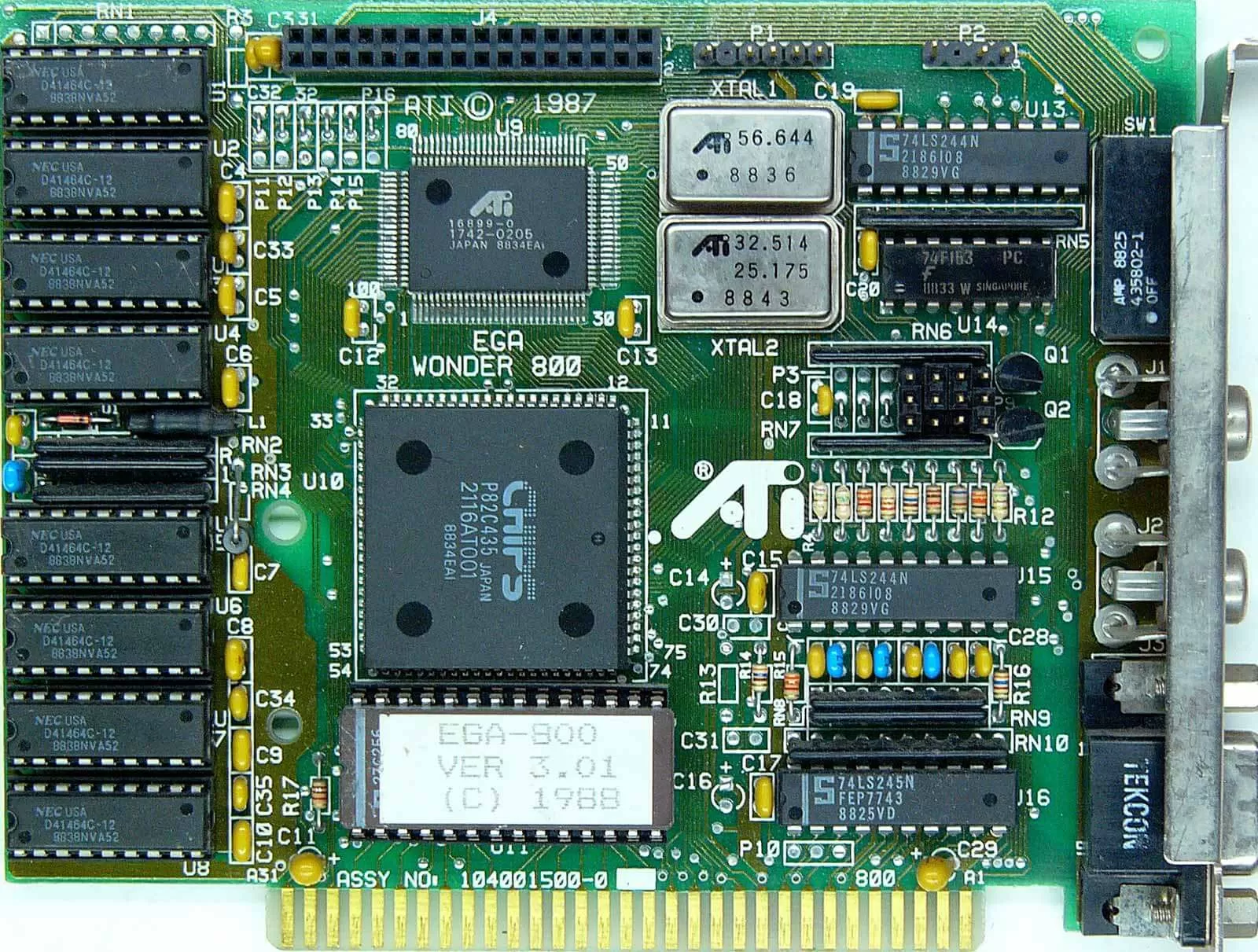
The EGA Wonder series 1 to 4 arrived in March for $399, featuring 256KB of DRAM too as compatibility with CGA, EGA and MDA emulation with up to 640x350 and sixteen colors. Extended EGA was available for the series two,3 and 4.
Filling out the high end was the EGA Wonder 800 with sixteen-color VGA emulation and 800x600 resolution back up, and the VGA Improved Performance (VIP) card, which was basically an EGA Wonder with a digital-to-analog (DAC) added to provide limited VGA compatibility. The latter cost $449 plus $99 for the Compaq expansion module.
ATI was far from being alone riding the wave of consumer appetite for personal computing.
Many new companies and products arrived that year.. Among them were Trident, Sister, Tamerack, Realtek, Oak Applied science, LSI's Chiliad-two Inc., Hualon, Cornerstone Imaging and Winbond -- all formed in 1986-87. Meanwhile, companies such as AMD, Western Digital/Paradise Systems, Intergraph, Cirrus Logic, Texas Instruments, Gemini and Genoa, would produce their first graphics products during this timeframe.
ATI'southward Wonder series connected to gain prodigious updates over the next few years.
In 1988, the Small Wonder Graphics Solution with game controller port and composite out options became available (for CGA and MDA emulation), every bit well as the EGA Wonder 480 and 800+ with Extended EGA and xvi-bit VGA back up, and besides the VGA Wonder and Wonder 16 with added VGA and SVGA support.
A Wonder 16 was equipped with 256KB of memory retailed for $499, while a 512KB variant toll $699.
An updated VGA Wonder/Wonder xvi series arrived in 1989, including the reduced price VGA Edge xvi (Wonder 1024 serial). New features included a bus-Mouse port and back up for the VESA Feature Connector. This was a golden-fingered connector like to a shortened data jitney slot connector, and it linked via a ribbon cablevision to another video controller to bypass a congested information bus.
The Wonder series updates continued to movement speedily in 1991. The Wonder Twoscore carte added VESA 32K colour compatibility and a Sierra RAMDAC, which additional maximum brandish resolution to 640x480 @ 72Hz or 800x600 @ 60Hz. Prices ranged through $249 (256KB), $349 (512KB), and $399 for the 1MB RAM pick. A reduced cost version chosen the VGA Charger, based on the previous twelvemonth'due south Bones-16, was also made available.

The Mach serial launched with the Mach8 in May of that yr. It sold equally either a scrap or board that allowed, via a programming interface (AI), the offloading of limited 2d drawing operations such as line-depict, color-fill up and bitmap combination (Flake BLIT).ATI added a variation of the Wonder XL that incorporated a Creative Audio Blaster i.5 bit on an extended PCB. Known as the VGA Stereo-F/X, it was capable of simulating stereo from Audio Blaster mono files at something approximating FM radio quality.
Graphics boards such as the ATI VGAWonder GT, offered a second + 3D option, combining the Mach8 with the graphics core (28800-2) of the VGA Wonder+ for its 3D duties. The Wonder and Mach8 pushed ATI through the CAD$100 million sales milestone for the year, largely on the dorsum of Windows iii.0'southward adoption and the increased 2nd workloads that could be employed with it.
S3 Graphics was formed in early 1989 and produced its offset 2D accelerator chip and a graphics carte du jour xviii months later, the S3 911 (or 86C911). Key specs for the latter included 1MB of VRAM and 16-bit colour support.
The S3 911 was superseded past the 924 that aforementioned twelvemonth -- it was basically a revised 911 with 24-scrap color -- and once again updated the post-obit twelvemonth with the 928 which added 32-chip color, and the 801 and 805 accelerators. The 801 used an ISA interface, while the 805 used VLB. Betwixt the 911's introduction and the advent of the 3D accelerator, the market was flooded with second GUI designs based on S3's original -- notably from Tseng labs, Cirrus Logic, Trident, IIT, ATI's Mach32 and Matrox'due south MAGIC RGB.
In January 1992, Silicon Graphics Inc (SGI) released OpenGL one.0, a multi-platform vendor doubter awarding programming interface (API) for both 2nd and 3D graphics.
Microsoft was developing a rival API of their own called Direct3D and didn't exactly break a sweat making sure OpenGL ran too as it could under Windows.
OpenGL evolved from SGI's proprietary API, called the IRIS GL (Integrated Raster Imaging System Graphical Library). Information technology was an initiative to keep non-graphical functionality from IRIS, and allow the API to run on non-SGI systems, as rival vendors were starting to loom on the horizon with their own proprietary APIs.
Initially, OpenGL was aimed at the professional UNIX based markets, simply with programmer-friendly support for extension implementation it was chop-chop adopted for 3D gaming.
Microsoft was developing a rival API of their own chosen Direct3D and didn't exactly break a sweat making sure OpenGL ran equally well as it could under the new Windows operating systems.
Things came to a head a few years later when John Carmack of id Software, whose previously released Doom had revolutionised PC gaming, ported Convulse to utilise OpenGL on Windows and openly criticised Direct3D.

Microsoft's intransigence increased as they denied licensing of OpenGL's Mini-Client Driver (MCD) on Windows 95, which would allow vendors to cull which features would take admission to hardware acceleration. SGI replied by developing the Installable Client Commuter (ICD), which not simply provided the same power, but did then even better since MCD covered rasterization only and ICD added lighting and transform functionality (T&L).
During the rise of OpenGL, which initially gained traction in the workstation arena, Microsoft was decorated eyeing the emerging gaming market with designs on their ain proprietary API. They acquired RenderMorphics in February 1995, whose Reality Lab API was gaining traction with developers and became the core for Direct3D.
At about the same time, 3dfx's Brian Hook was writing the Glide API that was to become the dominant API for gaming. This was in role due to Microsoft's interest with the Talisman projection (a tile based rendering ecosystem), which diluted the resources intended for DirectX.
As D3D became widely available on the dorsum of Windows adoption, proprietary APIs such as S3d (S3), Matrox Simple Interface, Creative Graphics Library, C Interface (ATI), SGL (PowerVR), NVLIB (Nvidia), RRedline (Rendition) and Glide, began to lose favor with developers.
It didn't aid matters that some of these proprietary APIs were allied with board manufacturers nether increasing pressure to add together to a rapidly expanding feature listing. This included higher screen resolutions, increased color depth (from xvi-bit to 24 and and then 32), and image quality enhancements such as anti-aliasing. All of these features called for increased bandwidth, graphics efficiency and faster product cycles.
By 1993, marketplace volatility had already forced a number of graphics companies to withdraw from the concern, or to be absorbed by competitors.
The year 1993 ushered in a flurry of new graphics competitors, most notably Nvidia, founded in January of that twelvemonth by Jen-Hsun Huang, Curtis Priem and Chris Malachowsky. Huang was previously the Director of Coreware at LSI while Priem and Malachowsky both came from Sun Microsystems where they had previously adult the SunSPARC-based GX graphics architecture.
Fellow newcomers Dynamic Pictures, ARK Logic, and Rendition joined Nvidia shortly thereafter.
Market volatility had already forced a number of graphics companies to withdraw from the concern, or to be absorbed by competitors. Amid them were Tamerack, Gemini Technology, Genoa Systems, Hualon, Headland Technology (bought by SPEA), Acer, Motorola and Acumos (bought by Cirrus Logic).
One company that was moving from strength to strength all the same was ATI.
Equally a forerunner of the All-In-Wonder series, late Nov saw the announcement of ATI's 68890 PC TV decoder bit which debuted within the Video-It! bill of fare. The scrap was able to capture video at 320x240 @ 15 fps, or 160x120 @ thirty fps, equally well as compress/decompress in existent fourth dimension thanks to the onboard Intel i750PD VCP (Video Compression Processor). It was besides able to communicate with the graphics lath via the information double-decker, thus negating the demand for dongles or ports and ribbon cables.
The Video-Information technology! retailed for $399, while a lesser featured model named Video-Basic completed the line-upward.
Five months later, in March, ATI tardily introduced a 64-bit accelerator; the Mach64.
The financial year had not been kind to ATI with a CAD$2.seven meg loss as it slipped in the marketplace amid stiff competition. Rival boards included the S3 Vision 968, which was picked up by many lath vendors, and the Trio64 which picked up OEM contracts from Dell (Dimension XPS), Compaq (Presario 7170/7180), AT&T (Globalyst),HP (Vectra VE 4), and DEC (Venturis/Celebris).

Released in 1995, the Mach64 notched a number of notable firsts. Information technology became the showtime graphics adapter to be available for PC and Mac computers in the form of the Xclaim ($450 and $650 depending on onboard memory), and, along with S3's Trio, offered full-motion video playback dispatch.
The Mach64 also ushered in ATI's first pro graphics cards, the 3D Pro Turbo and 3D Pro Turbo+PC2TV, priced at a cool $599 for the 2MB selection and $899 for the 4MB.

The following calendar month saw a technology start-up called 3DLabs ascension onto the scene, born when DuPont's Pixel graphics segmentation bought the subsidiary from its parent company, forth with the GLINT 300SX processor capable of OpenGL rendering, fragment processing and rasterization. Due to their high price the visitor's cards were initially aimed at the professional market. The Fujitsu Sapphire2SX 4MB retailed for $1600-$2000, while an 8MB ELSA GLoria 8 was $2600-$2850. The 300SX, however, was intended for the gaming market place.
S3 seemed to be everywhere at that time. The loftier-end OEM marked was dominated by the company's Trio64 chipsets that integrated DAC, a graphics controller, and clock synthesiser into a unmarried chip.
The Gaming GLINT 300SX of 1995 featured a much-reduced 2MB of memory. It used 1MB for textures and Z-buffer and the other for frame buffer, just came with an option to increase the VRAM for Direct3D compatibility for another $50 over the $349 base price. The carte failed to brand headway in an already crowded market, merely 3DLabs was already working on a successor in the Permedia series.
S3 seemed to be everywhere at that time. The high-end OEM marked was dominated by the company's Trio64 chipsets that integrated DAC, a graphics controller, and clock synthesiser into a single chip. They also utilized a unified frame buffer and supported hardware video overlay (a dedicated portion of graphics memory for rendering video every bit the application requires). The Trio64 and its 32-bit retention bus sibling, the Trio32, were available equally OEM units and standalone cards from vendors such as Diamond, ELSA, Sparkle, STB, Orchid, Hercules and Number 9. Diamond Multimedia'southward prices ranged from $169 for a ViRGE based card, to $569 for a Trio64+ based Diamond Stealth64 Video with 4MB of VRAM.
The mainstream cease of the market as well included offerings from Trident, a long time OEM supplier of no-frills 2D graphics adapters who had recently added the 9680 flake to its line-upwards. The chip boasted most of the features of the Trio64 and the boards were generally priced around the $170-200 mark. They offered acceptable 3D operation in that bracket, with practiced video playback capability.
Other newcomers in the mainstream marketplace included Weitek's Power Player 9130, and Alliance Semiconductor'south ProMotion 6410 (commonly seen as the Alaris Matinee or FIS's OptiViewPro). Both offered excellent scaling with CPU speed, while the latter combined the potent scaling engine with antiblocking circuitry to obtain smooth video playback, which was much better than in previous chips such equally the ATI Mach64, Matrox MGA 2064W and S3 Vision968.

Nvidia launched their first graphics fleck, the NV1, in May, and became the first commercial graphics processor capable of 3D rendering, video acceleration, and integrated GUI acceleration.
They partnered with ST Microelectronic to produce the chip on their 500nm process and the latter also promoted the STG2000 version of the chip. Although it was non a huge success, it did stand for the first fiscal render for the visitor. Unfortunately for Nvidia, merely every bit the start vendor boards started shipping (notably the Diamond Border 3D) in September, Microsoft finalized and released DirectX one.0.
The D3D graphics API confirmed that it relied upon rendering triangular polygons, where the NV1 used quad texture mapping. Limited D3D compatibility was added via driver to wrap triangles as quadratic surfaces, merely a lack of games tailored for the NV1doomed the card every bit a jack of all trades, master of none.
Most of the games were ported from the Sega Saturn. A 4MB NV1 with integrated Saturn ports (two per expansion bracket connected to the card via ribbon cablevision), retailed for around $450 in September 1995.
Microsoft's late changes and launch of the DirectX SDK left lath manufacturers unable to direct access hardware for digital video playback. This meant that virtually all discrete graphics cards had functionality issues in Windows 95. Drivers under Win 3.one from a multifariousness of companies were generally faultless by contrast.

The commencement public demonstration of it came at the E3 video game conference held in Los Angeles in May the following year. The bill of fare itself became available a month later. The 3D Rage merged the 2d cadre of the Mach64 with 3D capability.ATI announced their offset 3D accelerator chip, the 3D Rage (also known every bit the Mach 64 GT), in Nov 1995.
Tardily revisions to the DirectX specification meant that the 3D Rage had compatibility bug with many games that used the API -- mainly the lack of depth buffering. With an on-board 2MB EDO RAM frame buffer, 3D modality was express to 640x480x16-bit or 400x300x32-fleck. Attempting 32-scrap colour at 600x480 generally resulted in onscreen color corruption, and 2D resolution peaked at 1280x1024. If gaming performance was mediocre, the full screen MPEG playback ability at to the lowest degree went some manner in balancing the feature prepare.
The functioning race was over before information technology had started, with the 3Dfx Voodoo Graphics effectively annihilating all competition.
ATI reworked the flake, and in September the Rage II launched. Information technology rectified the D3DX issues of the start chip in add-on to adding MPEG2 playback support. Initial cards, however, still shipped with 2MB of memory, hampering performance and having problems with perspective/geometry transform, As the series was expanded to include the Rage Two+DVD and 3D Xpression+, memory capacity options grew to 8MB.
While ATI was first to market with a 3D graphics solution, information technology didn't have too long for other competitors with differing ideas of 3D implementation to arrive on the scene. Namely, 3dfx, Rendition, and VideoLogic.
In the race to release new products into the marketplace, 3Dfx Interactive won over Rendition and VideoLogic. The performance race, however, was over earlier it had started, with the 3Dfx Voodoo Graphics finer annihilating all competition.
This is the first commodity on our History of the GPU series. If you enjoyed this, continue reading as nosotros have a stroll downwardly memory lane to the heyday of 3Dfx, Rendition, Matrox and young company called Nvidia.

Source: https://www.techspot.com/article/650-history-of-the-gpu/
Posted by: faysuildrued.blogspot.com
0 Response to "The History of the Modern Graphics Processor"
Post a Comment